
Why Traditional L2 Chinese Acquisition Fails — and the Science of What Actually Works
Is Chinese hard, or is the method misaligned? Discover the first-principles logic that enables Meta-Learners to bypass the 5-year "Sisyphus Trap" to achieve high-fidelity Chinese proficiency, with 66% less time in the 100-Day DragonStreak™ Bootcamp.

From Sisyphus to Transformation in Your Chinese Language Learning
After twelve years of frontline teaching and research into cognitive processing in Chinese acquisition, a clear pattern has emerged: the primary cause of failure in L2 Chinese Acquisition (learn Chinese as a Second/foreign Language) is what we term Structural Misalignment. Contrary to the common belief that “Chinese is hard,” the root cause is a systemic misalignment—the attempt to force a logographic script through alphabet-based cognitive frameworks.
At the MetaChinese Institute, we move beyond the Sisyphean cycle of rote memorization to establish Structural Literacy. This is a learning architecture grounded in Information Theory and Entropy Reduction, powered by the Total Radical System (TRS)—a mechanism designed to honor both the linguistic structure of Chinese and the cognitive capacity of the learner.
The following executive summary outlines the logic, derived from First Principles reasoning, that enables Meta-Learners to bypass years of wasted effort. We do not ask you to work harder; we empower you to achieve High-Fidelity Proficiency by aligning with the fundamental physics of the Chinese language.
⚡ Executive Summary: The Logic of Structural Literacy
- The Structural Misalignment: Chinese is a logographic language, but traditional L2 instruction applies alphabetic, phonetic-first pedagogy. This mismatch creates a high-entropy learning environment where sound cannot reliably stabilize meaning. From an information-theoretic perspective, unanchored phonetic input decays rapidly, leading to The Sisyphus Trap. The resulting failure is systemic—not a deficit of learner ability.
- The Engine of L2 Chinese Acquisition — The Total Radical System (TRS) functions as the structural operating system for logographic language, replacing rote memorization with pattern recognition. By assigning each logogram a stable visual address through its meaning-bearing components (morphemes), TRS anchors meaning structurally, transforming high-entropy input into a coherent, connected semantic network.
- The Mastery-Based Dividend: By establishing Confidence Anchors in both sound (Mandarin Etudes) and writing-meaning units (TRS), Meta-Learners bypass the phonetic bottleneck and reach HSK 4 / AP Chinese 3.3× faster than traditional instructional baselines.
- The Objective: To replace mechanical, high-entropy drills with a Structural Learning Architecture. We bypass the Sisyphus Trap of rote memorization to deliver High-Fidelity Mandarin Chinese Competency and Cross-Cultural Communication at scale. In the process, learners develop the cognitive clarity and meta-learning skills—the Intellectual & Cultural Agency—required to navigate complex global systems in the age of AI.
1. The Sisyphus Trap: High-Entropy Learning
Most Chinese learners—from beginners to those grinding for HSK 4—are like Sisyphus, pushing the boulder of "whole-character memorization" up a hill using flashcards, only for biological memory attrition to push it back down every night.
This is not a failure of your ability. It is a systemic failure of the method.
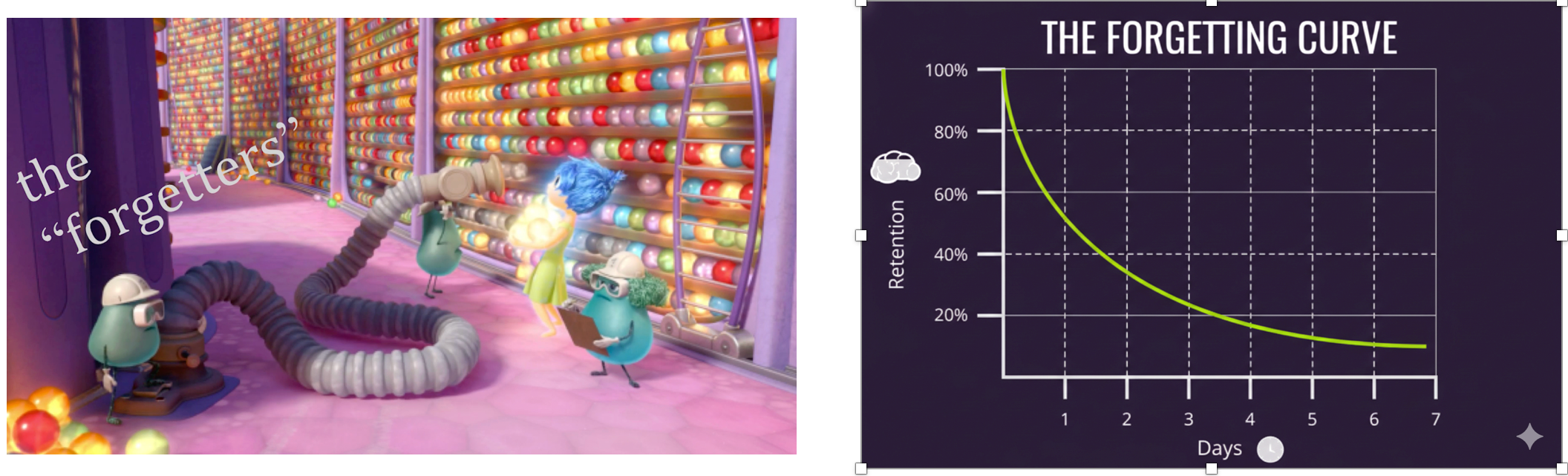
From a cognition perspective, language learning—whether first or second language—is at its core an act of information processing.
Any system that transmits information operates under principles established in Claude Shannon’s 1948 landmark work, Information Theory.
In every communication channel, there is entropy: disorder, uncertainty, and noise that degrade signal quality.
L2 Chinese Acquisition is no different.
Rote memorization is high entropy; it treats every character as a random, disconnected data point. Without a structural anchor, the system inevitably collapses into Anchorless Drift..
2. The Root Cause: Systemic Mismatch.
2.1 Alphabet Thinking vs. Logographic Reality
FACT: Chinese is a Logographic Language.
Reality: Most instructional methods still teach it using Alphabet Thinking.
Alphabet-based systems rely on a stable decoding chain: written form → sound → meaning. In these systems, meaning is accessed through sound.
That auditory pathway, however, is blocked in a logographic writing system.
Chinese characters directly encode meaning: written form → meaning. The phonological information of the character is retrieved via the learner’s lexical knowledge – mediated by pinyin as a Romanized sound annotation, but it does not provide a direct path to meaning.
Figure 2: Alphabetic vs. Logographic Encoding Pathways
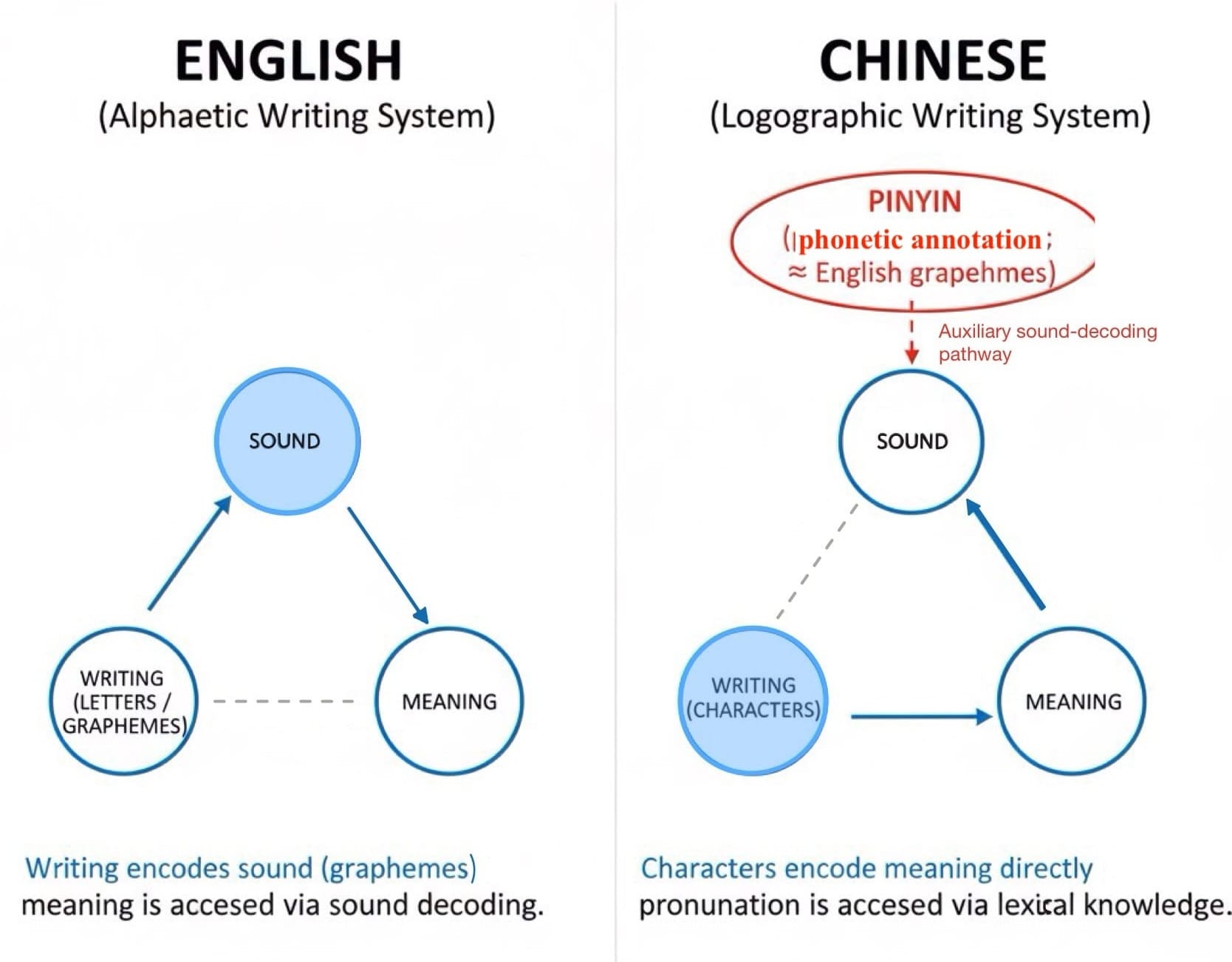
Note. Solid arrows represent stable encoding pathways supported by the writing system. Dashed arrows represent weak or unstable pathways. Pinyin operates as an auxiliary phonetic annotation to the sound.
Let’s look at a few simple examples.
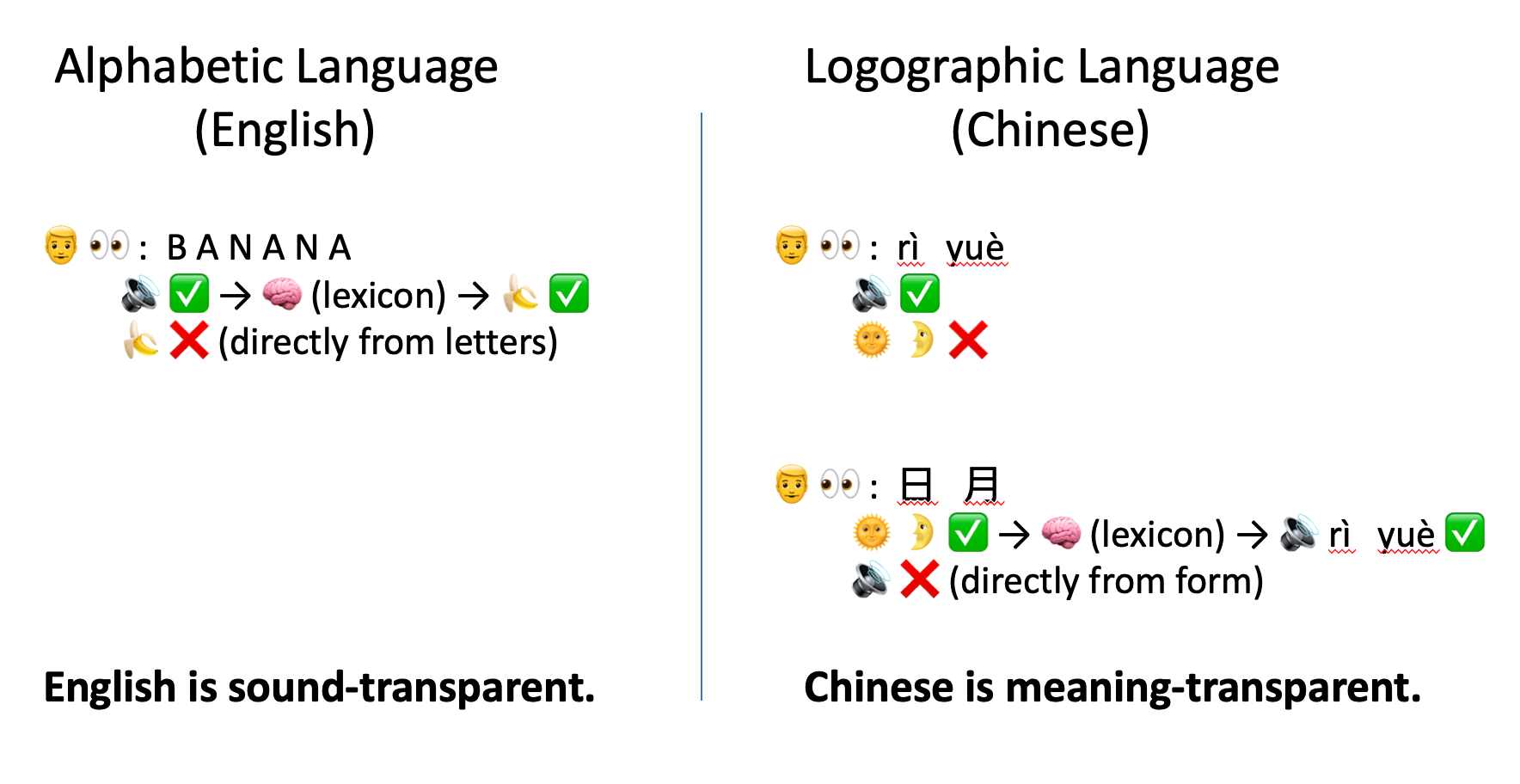
Imagine an English learner staring at the word BANANA. They can pronounce it instantly—but nothing in the letters themselves tells them it refers to a yellow fruit.
👨👀: B A N A N A
🔊 ✅→ 🧠(lexicon) →🍌 ✅
🍌 ❌(directly from letters)
Now imagine looking at rì in pinyin. Again, pronunciation is available, but meaning is not.
👨 👀 : rì yuè
🔊 ✅
🌞 🌛 ❌
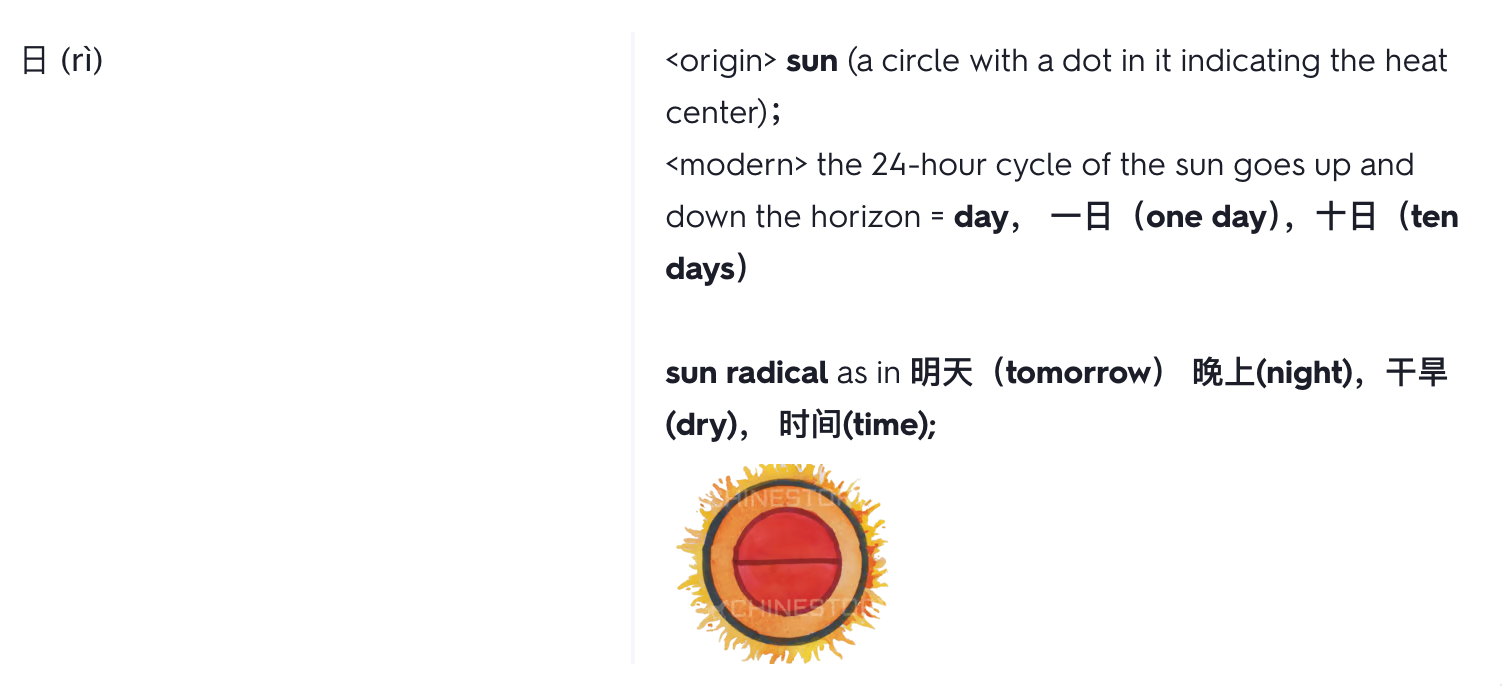
But look at the character 日. The form itself encodes a referent: the sun, with a heat spot at its center 🌞.
Now look at the character 月. Does its form resemble a crescent moon 🌛? Immediately.
👨 👀: 日 月
🌞🌛 ✅ → 🧠(lexicon) → 🔊rì yuè ✅
🔊 ❌(directly from characters)
You can think of these characters as low-fidelity emojis. Just as emojis convey meaning without sound, Chinese characters encode meaning directly rather than phonetic information.
This is the fundamental difference between alphabetic and logographic systems. One encodes sound directly. The other encodes meaning directly.
This fundamental difference is summarized in Figure 3 below.
Figure 3: Chinese Characters as Low-Fidelity Emojis — Representing the Semantic-First Encoding System
When the teaching method treats phonetic annotation as a decoding mechanism rather than metadata, it misaligns with the linguistic structure of the script. The result is a substantial “efficiency tax”—unnecessary cognitive load, slower acquisition, and fragile retention.
2.2 The Phonetic Collision: Why Listening "Crushes" the Learner
In an alphabet language such as English, word sound is a unique identifier (e.g., "Banana" has one meaning). In Chinese, you face a High-Compression Bottleneck.
- The Math: English phonology exhibits low semantic collision: over 92% of word forms map to unique meanings. Mandarin Chinese, by contrast, is largely monosyllabic, operating on roughly 400 base syllables differentiated by four lexical tones— that are notoriously difficult for L2 learners to distinguish. As a result, a single spoken syllable must carry as high as 10+ distinct characters (morphemes), creating extreme high entropy at the phonetic level.
- The Result: For L2 learners, Mandarin sound rarely anchors meaning. You hear shi, hesitate, your brain enters a processing loop, cycling through the few meanings you know, and before anything fully resolves, the conversation has already moved on. Without a semantic structure to attach to, sound alone offers no stable foothold.
- The Collapse: This is why even HSK 4 learners feel "crushed" in immersion. Their auditory hardware is overheating because it lacks the visual-semantic anchors required to filter the collision.
- The Solution: You cannot anchor in sound; you must anchor in visual-semantic logic. Chinese characters are not "extra work"—they are the Visual Address your brain needs to stabilize meaning, and resolve collisions. This is the most effective path to L2 Chinese Acquisition Without Immersion.
3.The Solution: The Total Radical System (TRS)
To escape the Alphabet Trap, you need an Operating System designed for logographic reality. The Total Radical System (TRS) is that engine. It operates on two critical levels to eliminate the inefficiencies of traditional learning.
3.1. The Visual Operation: From "Random Squiggles" to Coded Logic
The first hurdle is the "Drawing Trap." Traditional pedagogy treats characters as holistic "pictures" to be memorized through muscle memory. To the brain, these are just random squiggles—high-entropy visual noise.
The TRS breaks this cycle by identifying the 200+ fundamental patterns (Radix) that serve as the DNA of the language. By mastering these visual-semantic building blocks, you stop "drawing symbols" and start recognizing a coded system.
The TRS is the mechanical "how" that stops the Sisyphus boulder from rolling back down by giving you a structural grip on the script.
Figure 4: An example Chinese Radix
3.2. The Auditory Operation: Taming the "Phonetic Collision."
The second hurdle is the "Phonetic Collision." In Chinese, sound is a high-entropy signal; one syllable can map to ten different meanings.
Attempting to anchor meaning via sound alone leads to 'Anchorless Drift'—where the brain cannot decode fast enough to keep up. Total Radical System (TRS) provides the missing visual anchors, turning a chaotic auditory experience into a stable, predictable Chinese semantic network.
- The Radix as Beacon: In the TRS, each radical functions as a Beacon—a stable, recurring visual pattern that signals a Semantic Core. Instead of fighting the phonetic fog, learners are trained to spot these Beacons. Once a Beacon is identified, meaning is anchored structurally, rather than guessed through sound.
- The TRS Advantage: You move from "guessing" via sounds to "locating” meaning via a “visual address”. The TRS equips learners with high-fidelity visual-semantic signal processing skill, allowing comprehension to keep pace with real discourse rather than lag behind a congested phonetic channel.
Traditional “whole-character memorization” is in essence alphabet thinking because characters are copied by sound, not understood by structure. Table 1 below summarizes the differences between traditional alphabet thinking vs. TRS.
Table 1 : Sound-First (Alphabet Thinking) vs Total Radical System (TRS)
4: The Result — Building Your Chinese Semantic Network
While the Total Radical System (TRS) is the engine, the Chinese Semantic Network is the lasting cognitive asset it builds.
Chinese characters are not arbitrary symbols. Each radix comes from the oracle bone script nearly 5,000 years ago and refers to a real-world object or experience. These ancient forms are the semantic DNA of the modern script—and because they are grounded in reality, they are highly reusable.
This reusability creates a compounding effect. One meaning does not stand alone; it connects, extends, and reinforces others. Learning stops being linear and becomes networked.
Instead of copying strokes, learners trained through TRS learn to see structure. This aligns with how the brain naturally excels at visual thinking, pattern recognition, and logic.
For example, 自 originally depicts nose bridge. Point to your own nose, and you are referring to yourself—hence 自己 (“oneself”).
The same radix extends into 鼻 (nose)。 This character is visually stacked: top 自—nose bridge; middle 田—looks like the nostrils; bottom—airflow, breathing moving through the nose. Meaning is embedded directly in the form.
You will find the same radix in 息, where breath passes through the nose 自 and settles at the heart 心. Combined with 休 (a person 亻 leaning against a tree 木), 休息 becomes more than “rest”—it reflects both physical stillness and inner regulation.
Characters no longer exist as isolated items. Each new word slots into the semantic network, strengthening what is already there. This is the compounding effect in action.
By bypassing phonetic bottlenecks and reconnecting script directly to meaning, learners move from fragile recall to durable comprehension, and ultimately High-Fidelity Proficiency.
You no longer memorize characters. You integrate them.
Learn one—and the network allows you to know ten.
5. The Intellectual Dividend: Learning in the AI Era
This approach transforms language learning from mechanical memorization into an act of curious discovery. In an age of AI and instant translation, stuffing your brain with isolated facts is a sure dead end.
The real dividend is intellectual agency.
Through the TRS, you don’t just learn what words mean—you learn how meaning is constructed. Characters become entry points into history, philosophy, and lived experience. When you see that 休 encodes physical stillness and 息 encodes breath observing the heart, you’re not memorizing definitions—you’re encountering a way of understanding the body, the mind, and self-regulation embedded in the language itself.
This is where language learning becomes a way of life.
You develop cross-cultural proficiency, the ability to read beneath the surface, and the habit of seeking structure rather than brute force. You learn how civilizations are encoded in language, how language conveys values, how to think with depth and clarity.
In the AI era, machines can translate words instantly. What they cannot replace is your curiosity and intellectual agency.
Structural Literacy gives you that edge: learning faster without becoming mechanical, thinking clearly without losing depth. This gives you the Cultural Agency to read beneath the surface—a lens on the world that no algorithm can replace.
6. From Theory to Transformation: The Dragon Streak Bootcamp
Understanding why status-quo methods fail is only the beginning. Real mastery requires Behavioral Conditioning—a system that respects both the linguistic reality of Chinese and the biological reality of human learning.
If you are ready to stop rolling the boulder and start building an efficient, sustainable path that is intuitive, rigorous, and intellectually rewarding:
Find out how the Dragon Streak works and if it is a good fir for you. (link) →
Through three structured Dragon Streak cycles, learners progress from beginner to HSK 4 by:
- Cutting 66% off the traditional five-year timeline
- Building a permanent Semantic Network that survives the forgetting curve
- Designed for Meta-Learners who refuse to settle for the 5-year grind.